For years, Ocean Safety Lieutenant Chelsea Kahalepauole Bizik worked out of her truck and a nook between the restrooms at Kailua Beach Park. Aloha State Daily reported that she now has an office in the new Kailua Operations Annex, on Kaneapu Place across from the Kailua Beach Boat Ramp.
The City finished the building on November 4. It is the first facility ever built specifically for Honolulu's ocean lifeguards, and the department is 109 years old. The annex is the latest in a series of changes over the past two years, as Kailua Beach Park has given up its temporary arrangements one at a time. The lifeguards have moved out of a nook, the sand fencing now has native trees growing behind it, and the late-night closure has gone from a pilot to a standing rule. All three changes point the same way.
What Moved Into 592 Kaneapu Place
Hawaii News Now reported the annex was operational at 592 Kaneapu Place, and retired lifeguard Kahu Dennis Salas performed the blessing. According to the City's announcement, the project cost $3.3 million, was built by CC Engineering & Construction, Inc., and replaces the interim quarters Ocean Safety had been using.
The 1,680 square feet hold:
- Two offices
- A bathroom and a kitchenette
- A board storage room
- An apparatus bay for trucks and watercraft
Aloha State Daily describes the bay as a garage for trucks and two jet skis. The building is home to two lieutenants and Rescue 6, a rescue watercraft team formed in 2013. Captain J.R. Sloane leads operations from Maunalua Bay to the Mōkapu Peninsula, and he described the unit's role to the outlet:
"Rescue 6 is a legitimate and necessary rescue unit in which specially trained lifeguards who educate the public, make proactive, preventative actions to keep people from getting into dangerous, life threatening situations and then rescuing them and providing basic life support when they do."
The numbers show where most of that work happens. Citing Ocean Safety data, Aloha State Daily reported that Rescue 2 and Rescue 6, the two rescue teams on the Windward coast, logged 35,686 interactions with beachgoers in 2025 and rescued 134 people. That is roughly 266 conversations for every rescue, which fits the prevention-first job Sloane describes. The same article says Kailua Beach drew more than 1.5 million visitors last year, making it the fourth most visited beach on Oʻahu. The City says staff based at the annex will cover the coastline from the Mōkapu Peninsula to Waimānalo Bay.
The Sand Has Been Getting the Same Treatment
Since November 2024, the Department of Parks and Recreation has been working with the State's Office of Conservation and Coastal Lands, Hawaiʻi Sea Grant, the City's climate office, and Windward community volunteers on the eroding shoreline between Kailua Road and the boat ramp. The project page lays out the order of work, and each phase sets up something more lasting than the one before:
| When | What happened | Where |
|---|---|---|
| Nov. 2024 to July 2025 | Ironwood stumps, leaning trees, broken irrigation lines, eroding concrete and damaged benches removed | Restoration area |
| Jan. to Feb. 2025 | Sand moved back to the shoreline to ease steep drop-offs | Near the parking lot, shower and comfort station |
| Feb. 2025 | Temporary sand fencing and educational signs installed | Phase 1 area |
| May 31, 2025 | 344 native ground-cover plants installed | Between the canoe hale parking lot and Lifeguard Tower 8B |
| Sept. 27, 2025 | More than 150 volunteers planted 1,800 plants in two hours | Main planting area and along the Kaʻelepulu Stream bank |
| Aug. 29, 2026 | First trees planted: 11 milo, kou and heliotrope, plus 25 variegated naupaka and 300 ʻakiʻaki plugs | Makai of the canoe hale lot, Lanikai side of Kaʻelepulu Stream |
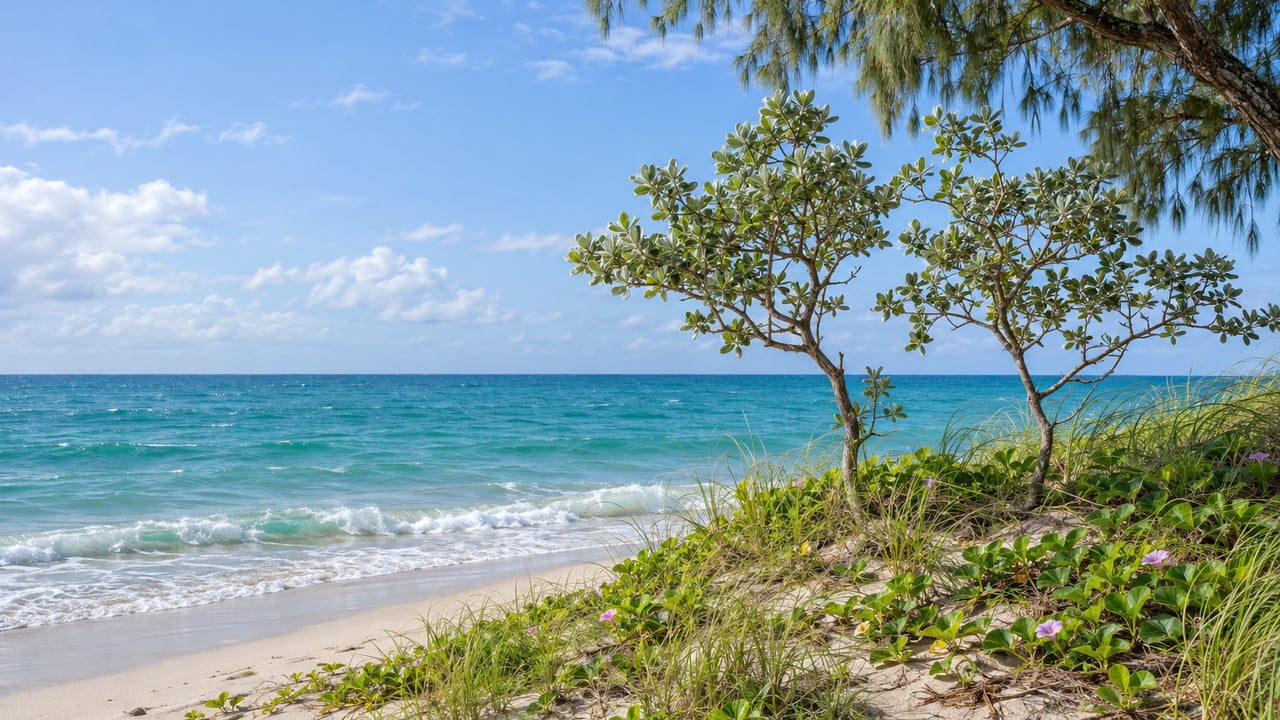
The ironwoods came out because they hold little sand in their roots and crowd out native plants. The ground cover of ʻakiʻaki, ʻākulikuli, pōhinahina and nanea is there to keep wind-blown sand from sliding off the beach. The temporary fencing went up in February 2025 to keep sand from blowing into the backshore, and three months later it also protected the newly planted ground cover. The August trees went into spots marked by 11 wooden posts on the mauka side of the beach.
The project page lists what comes next. More post-and-rope fencing is planned, with 20-foot-wide pathways to the water and more signs. Beach heliotrope, milo, hala or kou may be planted between the Kaʻelepulu Stream mouth and the Lanikai-side lifeguard stand, mauka of the ground cover. Low naupaka is planned in front of the parking lot to keep sand off the pavement. DPR says a community working group meets monthly and holds volunteer workdays. Anyone who wants to join can email [email protected], the contact listed on the project page.
The Overnight Hours Are No Longer a Trial
The park's rules have settled the same way. In September 2026, DPR made Kailua Beach Park's nightly closure from 12 midnight to 4 a.m. permanent. The hours started as a pilot program, and the decision followed community input formalized through the Neighborhood Board.
For anyone at the water before sunrise, the DPR announcement explains what the closure covers. You may walk through a closed park at any time, especially to reach the ocean. Staying in the park during those hours is illegal unless DPR has given permission. So a paddler heading out at 3:45 a.m. can cross the park, but a group settling onto the sand at that hour cannot stay.
Where the Permanent Pieces Sit
Most of these fixtures are on the Lanikai end of the park, so a walk from the stream to the boat ramp passes nearly all of them:
- Kaʻelepulu Stream. The Lanikai-side bank has ʻakiʻaki planted in September 2025, and the August 2026 trees stand just makai of the canoe hale parking lot.
- Canoe hale lot to Tower 8B. This is the strip where the first 344 ground-cover plants went in.
- The boat ramp. In 2025, dry, bleached sand stockpiled behind the Ocean Safety lifeguard stand was moved here for use in the dune work.
- Kaneapu Place. The annex sits across the street from the ramp, with Rescue 6's trucks and watercraft parked inside.
Early December on the Water
The state Ocean Safety directory lists Kailua Beach as guarded every day from 8 a.m. to 6:30 p.m. Makapuʻu, Waimānalo and Waimānalo Bay keep the same daily hours, and Bellows is guarded on weekends.
Mark December 2 through 4 if you swim. The Waikīkī Aquarium's box jellyfish calendar rates those days as high probability, with December 1 and 5 rated low. Honolulu Ocean Safety says box jellyfish regularly swarm south and leeward shores nine to 10 days after the full moon. The Aquarium notes that its dates are estimates and that jellyfish can show up on any day. It advises swimmers to follow beach signs, swim at guarded beaches, and ask a lifeguard. At Kailua, the lifeguards you would ask now work out of a building of their own a few steps from the boat ramp.
Changes like a new lifeguard base and a replanted shoreline shape how a beach park works from day to day. If you'd like to talk about life near Kailua Beach Park or anywhere else along the Windward coast, Diego Miranda is glad to share what he knows. Let's Connect.